
Most SaaS founders begin their messaging in the same place. They list features and describe what the product does. They lead with automation, integrations, dashboards, speed, AI and whatever their competitors also claim to have.
The problem with that is simple.
Feature-first copy is interchangeable. Any competitor can say the same thing, and many already do, so your SaaS messaging falls flat.
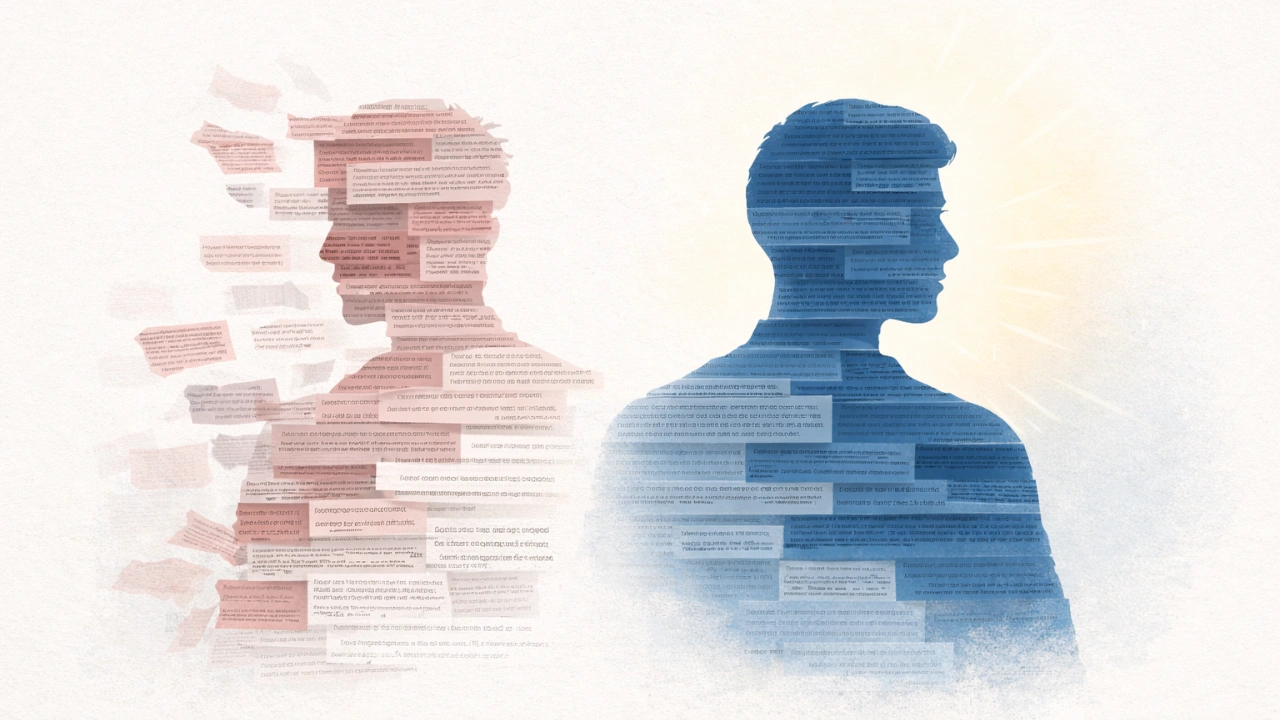
But in reality, you’re not selling a product at all. You’re selling your prospect a better version of themselves.
Features may support that transformation, but they’re never the only reason someone buys.
This distinction matters more in SaaS than almost any other industry, as software markets are crowded. Features are easy to copy, and product screenshots look similar.
Tapping into the emotional and practical transformation your customer wants is your differentiator. Highlight the gap between where visitors are now and who they want to become.
That’s what I’ll show you how to do.
What We Mean by a “Better Version of Themselves”
Listen up, I get it. You’ve spent heaps of time building your product and are super proud of it (and rightly so). Worked hard on the features, wrote and rewrote the code, fixed bugs, got everything back on track when it went off the rails.
So, I’m not trying to criticise the features or the tools themselves with what I’m about to write.
The idea of selling users a better version of themselves rests on a simple psychological truth: Customers don’t actually care much about your features or tools.
They don’t care about how much work you put into them. They definitely don’t care about the clever piece of code you wrote.
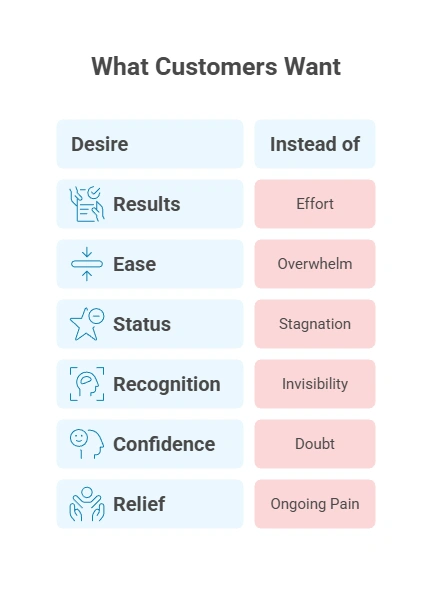
They want what your features and tools help them experience. They want:
- Results instead of effort
- Ease instead of overwhelm
- Status instead of stagnation
- Recognition instead of invisibility
- Confidence instead of doubt
- Relief instead of ongoing pain
The Feature-Led Messaging Trap
When a founder leans too heavily on features, none of the above human needs are addressed. You end up talking too much about yourself and not enough about your customer.
If you’ve ever been unfortunate enough to get stuck with someone at a party who won’t shut up about themselves, you can see why that’s a problem.
But reflect your prospect’s internal motivation (what they want life to feel like after solving their problem), and you connect with them.
This is good news for SaaS, because software exists to make life easier for users:
- Automation, so they can stop doing repetitive tasks
- Clarity, so decisions become easier
- Control, so nothing slips through the cracks
- Growth, so they can reach goals faster and with less friction
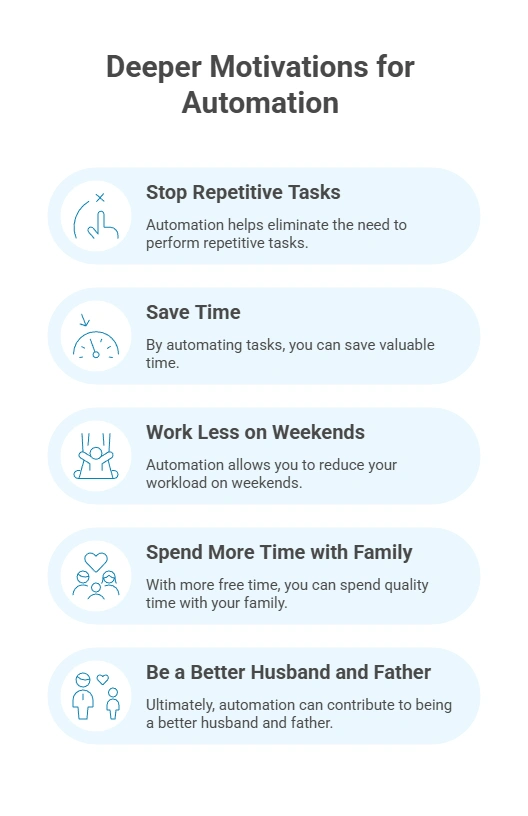
You can dig down into each one to uncover deeper motivations. Let’s quickly cover automation, say for a busy founder:
Automation ➡️ Stop doing repetitive tasks ➡️ Save time ➡️ Work less on weekends ➡️ Spend more time with family ➡️ Be a better husband and father
Of course, you’re not going to write: “Feature X makes you a better husband and father.”
But you might write something like: “Spend your time on what matters most.”
Then, the potential user can make the connection themselves.
Often, it’s hard for SaaS founders to shift away from feature-led messaging, especially as you’ve been in the feature trenches for so long, building and perfecting them.
You’re too close to the product.
But if you want to nail your messaging, zoom out, and bring it back to the customer:
- They’re not buying your tool.
- They’re buying a better version of themselves.
- Your tool is what helps them get there.
Your messaging becomes far more powerful the moment you stop describing what your product is and start describing who the customer becomes because of it.
Let’s go through the steps for writing SaaS messaging that sells a better version of your customer.
Step 1: Stop Thinking About Your Product, Start Studying Your Customer
To create killer SaaS messaging, don’t even think about writing yet. Close your Google or Notion doc. Stop thinking about your product.
The moment you begin writing from the perspective of…
- Your features
- Your roadmap
- Your internal language
… you cut yourself off from the only source of messages that actually convert. Your potential customer.
First:
- Understand who your visitor really is
- What situation they’re in
- What they want at a deeper emotional level
This is where many SaaS founders struggle.
You’re too close to the product. You know how it works, why it was built, which feature is technically impressive and what the team is proud of.
But potential customers don’t think like that. Your prospects care about themselves: their own lives, pressures, goals.
My co-founder, Emma, puts it like this:
People are frustrated by things like having to keep working after 7pm for the third time this week because their manual quoting processes rely too much on them.
That’s so true. They’re not attached to your feature set, per se. Their only concern is whether your product helps them become the person they want to be.
In Emma’s example, that might be someone who isn’t tethered to their business, who has a life outside it, who can have dinner with their family whenever they want. Someone who controls their business, not the other way around.
That’s why the conversion copywriting process we follow starts with deep research. High-performing messaging isn’t plucked from the ether. We’re not sitting around like a poet waiting for the muse.
Conversion copywriting comes from your customers’ words, motivations, fears, frustrations, desires and behaviour patterns. If you’re writing copy, until you gather that data, any messaging you write is guesswork.
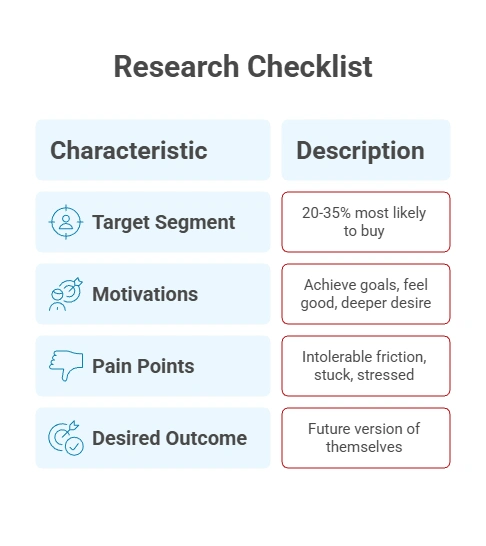
To anchor your research, use this quick checklist to define the core elements to uncover before you write a single line of copy:
1. Who is your real target segment?
Not your entire audience. Not your theoretical user base. The 20-35% who will get the most value from your product and are most likely to buy.
2. What motivates them?
What are they trying to achieve? How do they want to feel? What deeper desire pushes them to seek a solution in the first place?
3. What pain do they want resolved?
What is the intolerable friction they want eliminated? What is keeping them stuck, stressed or frustrated?
4. What does “better” look like to them?
Understand the future version of themselves they’re trying to reach and sell it back to them authentically.
Stop thinking about your product. Start studying the people who buy it.
Do that, and your messaging shifts from generic to magnetic.
You become the guy or gal at the party people are drawn to, while your competitors are over in the corner talking the ear off some poor soul, droning on about how great they are.
Step 2. Identify Their Pain, Desire and Deep Motivation
To write SaaS messaging that reflects a “better version” of your customer, understand the three emotional layers that shape buying behaviour:
- Pain
- Desire
- Motivation
Pain is what your customer wants to remove
It’s the friction, annoyance or recurring obstacle making their life harder. Your product should neutralise or eradicate a critical pain if you want customers to care about it.
Desire is what your customer wants more of
It could be simplicity, speed, clarity, competence or status. Desire is the positive direction they want to move toward.
Motivation is the deep (often unspoken) emotional driver
This is the layer most SaaS founders overlook because customers rarely articulate it directly. True motivations are generally emotional:
- To look competent at work
- To earn respect
- To keep up with colleagues
These motivations operate far beneath the surface of any stated goal.
Founders often stop at surface-level motivations like “save time” or “save money.” These are valid but insufficient, the beginning, not the end.
If your messaging stops there, it becomes generic and interchangeable with competitors making the same claims. How much SaaS messaging tells us we’re going to save time and money? It’s stated everywhere.
Digging deeper into motivations
We follow Copyhackers methods for digging deeper and uncovering what customers actually mean behind superficial goals.
Joanna Wiebe recommends a single survey question:
What’s happening in your life that brought you here today?
This open-ended question reveals context, emotional triggers and the real frustrations driving someone to your site. A good time to ask this question is after someone signs up for a trial, when they’re in a seducible moment.
Then, reinforce your insights using multiple sources:
- Competitor reviews: what users complain about and praise
- User testing: where testers stumble, hesitate or express concern
- Social media comments: raw, unfiltered reactions
- Support inboxes: recurring frustrations or expectations from customers
Tying these threads together helps you see the real story behind product usage. You see not just what users want to fix, but their deeper motivations.
You can translate these insights into transformation-oriented messaging.
Instead of: “Save time managing quotes.”
Write: “Feel in control of your workload and stop working weekends just to keep up.”
- Pain tells you what they want to escape.
- Desire tells you what they want to move toward.
- Motivation tells you who they want to be when they get there.
Your messaging should reflect all three. Nail that, and your SaaS copy will resonate on a deeper level and convert at a higher rate.
Step 3. Understand Your Customer’s Stage of Awareness
You need to meet your reader where they already are in their understanding of the problem, the solution and your product. Gene Schwartz’s awareness spectrum outlines how different levels of awareness require entirely different messaging approaches.
A visitor may be aware of their pain, aware that solutions exist, aware of your solution or unaware of all three. Each stage of awareness demands a different level of explanation and persuasion.
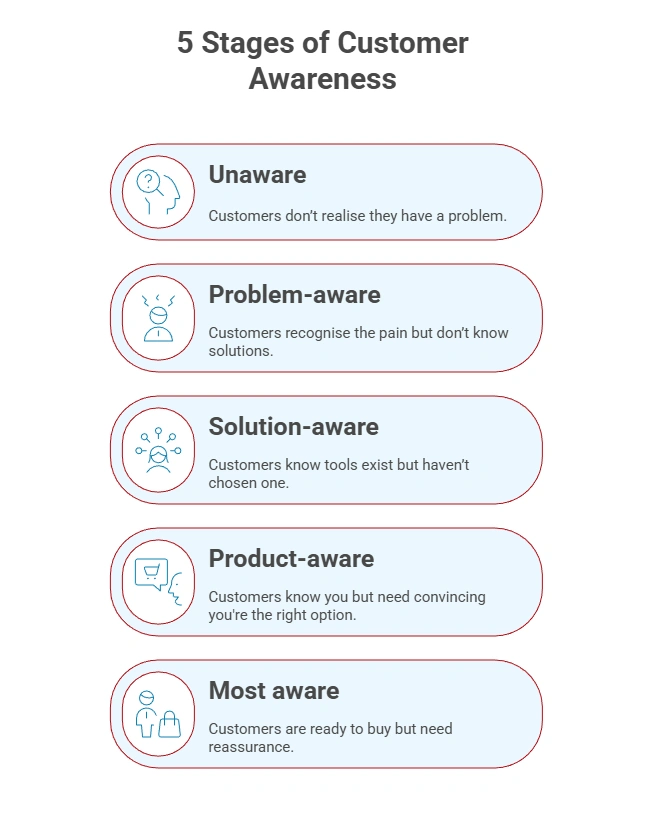
Here are the 5 stages of awareness:
- Unaware: They don’t realise they have a problem or don’t see it as urgent.
- Problem-aware: They recognise the pain but don’t know what solutions exist.
- Solution-aware: They know tools like yours exist but haven’t chosen one yet.
- Product-aware: They know who you are but need convincing that you’re the right option.
- Most aware: They’re ready to buy but need reassurance, clarity or a final nudge.
You can’t use the same approach for an unaware visitor and for someone who already knows your product. Awareness determines the length, depth, emotional tone and structure of your messaging.
Less aware audiences require more narrative, storytelling, context and motivation reflection, while more aware audiences require less education and more closing power (tight copy, proof, objection handling, clear calls to action).
Below are SaaS-specific examples for each stage:
1. Unaware
Example: A founder scrolling LinkedIn who doesn’t yet recognise that poor onboarding is hurting conversions.
Messaging needed: Story-driven content about the consequences of onboarding chaos, relatable pain points, and the aspirational future of smoother customer journeys.
2. Problem-aware
Example: Someone who knows their project deadlines are constantly slipping but hasn’t connected the issue to their task management approach.
Messaging needed: Show the pain clearly. Help them recognise what is causing the problem and how life could be different.
3. Solution-aware
Example: A business owner who knows project management tools exist but doesn’t know which one fits.
Messaging needed: Transformation messaging, side-by-side comparisons, outcomes, category differentiators.
4. Product-aware
Example: A visitor who has already read reviews of your platform and is comparing you with two other tools.
Messaging needed: Proof, social validation, unique strengths, objection handling, clarity around ROI.
5. Most aware
Example: Someone who has visited your pricing page three times and needs reassurance to buy.
Messaging needed: Confidence, guarantees, evidence, fast answers to concerns.
Here are a few quick points to remember:
- If you write as though the visitor already knows you, but they’re actually problem-aware, they feel lost.
- If you explain too much to someone who’s most aware, they feel frustrated.
- If awareness and messaging are misaligned, conversions fall.
Awareness targeting determines whether your SaaS messaging feels intuitive or confusing, compelling or irrelevant.
Step 4. Find the Exact Words Your Customers Use to Describe Their “Better Version”
Right, so we’ve done a deep dive on your customer now. You know their pain, desire, motivation and stage of awareness.
The next step is to extract “voice of customer” data, the exact language they use to describe their situation. Because your best messages don’t come from inside your head. They come directly from customers.
Whenever possible, you should use voice-of-customer messaging verbatim in your copy. These unpolished, unprompted phrases are rich with emotional nuance, context and specificity (the raw material that makes SaaS messaging feel real, not manufactured).
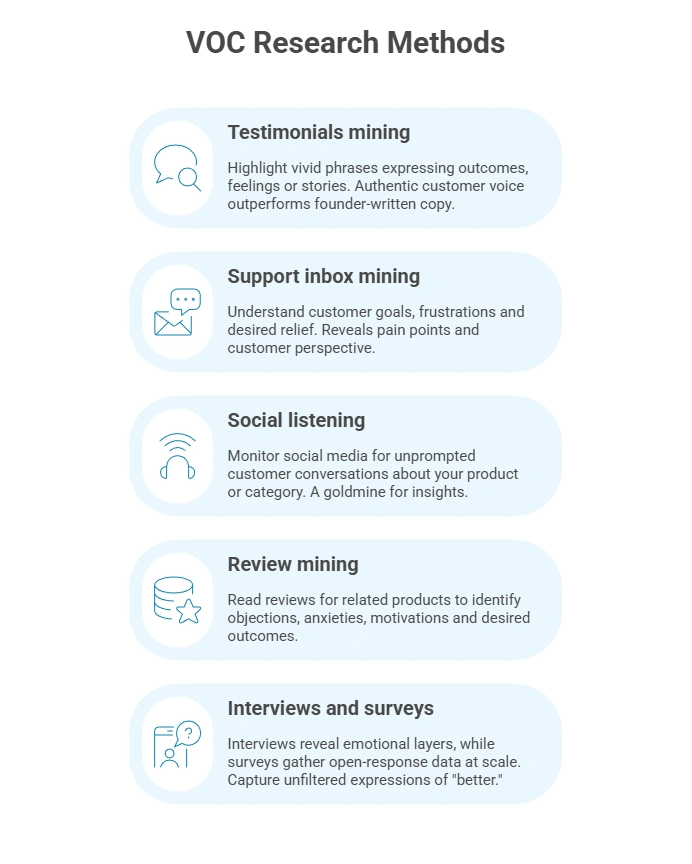
Here are several voice of customer (VOC) research methods:
Testimonials mining
Read through your testimonials with a highlighter in hand. Look for sticky, vivid phrases that express real outcomes, feelings or stories. A single line in a testimonial can outperform ten lines of founder-written copy because it captures the customer’s authentic voice.
Support inbox mining
Your support emails are full of insight. Customers explain what they were trying to achieve, what frustrated them, what broke and what relief they hoped for. These patterns reveal not only pain points but also what “better” looks like from their perspective.
Social listening
Tweets, comment threads, Facebook posts and Reddit show how customers talk about your product or category when no one is prompting them. If users are talking about your product, this can be an absolute goldmine.
Review mining
One of the most powerful conversion copywriting techniques is review mining. Reading reviews for books or products related to your problem space, not just your direct competitors, can help you identify objections, anxieties, motivations, frustrations and word-for-word expressions of desired outcomes.
Interviews and surveys
Interviews reveal emotional layers that customers rarely express in writing. Surveys allow you to gather open-response data at scale. Ask open-ended questions, let customers talk freely and avoid leading language, so you can capture unfiltered expressions of what “better” means to them.
These words outperform founder-written language for three reasons:
- They reflect how customers naturally think and speak.
Copy that feels familiar, not forced, builds trust and increases conversions. - They capture the emotional nuance that founders struggle to articulate.
Customers often reveal motivations or anxieties that founders never considered. - They reduce guesswork and prevent messaging drift.
If the words come from the customer, they are anchored in the customer’s reality, not internal assumptions.
When you use customer language verbatim, your messaging becomes a mirror. Prospects see themselves on the page, feel understood, confident they’re in the right place.
That emotional alignment is what moves them from reading to buying.
Your SaaS product may be the transformative tool. But customers’ words, reflecting who they want to become, are what sell it.
Step 5. Turn VOC Into a Messaging Hierarchy That Sells Transformation
Now, you’ve collected the raw voice of customer data. Your next task is to organise it into a structure that supports clear, compelling SaaS messaging.
Effective messaging must link motivation, state of awareness, pains and desires, value proposition, benefits, objections, social proof and incentives into one coherent hierarchy that guides the reader through the buying journey.
This hierarchy becomes the scaffold for your entire marketing ecosystem:
- Your homepage hero section should cover value proposition, motivation and state of awareness.
- Your landing pages unpack pain, desire, benefits,objections and social proof.
- Your onboarding sequence reinforces social proof and incentives to drive activation.
Here is how each layer works and how SaaS founders can use it.
1. Motivation: This sits at the top because it defines what your customer wants to feel after using your product. This shapes your transformation message.
2. Stage of awareness: This determines how much explaining you need to do. A product-aware visitor needs clarity. A problem-aware visitor needs education.
3. Pains and desires: Pains drive urgency. Desires pull users toward the better version of themselves. Together, they shape your “before” and “after” contrast.
4. Value proposition: This is where you connect customer motivation with your unique solution. It must speak directly to your target visitor segment.
5. Benefits: These expand on your value prop, showing how the product changes the customer’s day, workflow or results.
6. Objections: These are the hesitations, doubts or anxieties that must be addressed or removed so the prospect feels safe to proceed.
7. Social proof and reasons to believe: Testimonials, data points and authority elements back up your claims using other people’s words. These reinforce benefits and reduce risk.
8. Incentives: For the most aware visitors, incentives help close the sale. This could be a free trial, an onboarding bonus or a strong guarantee.
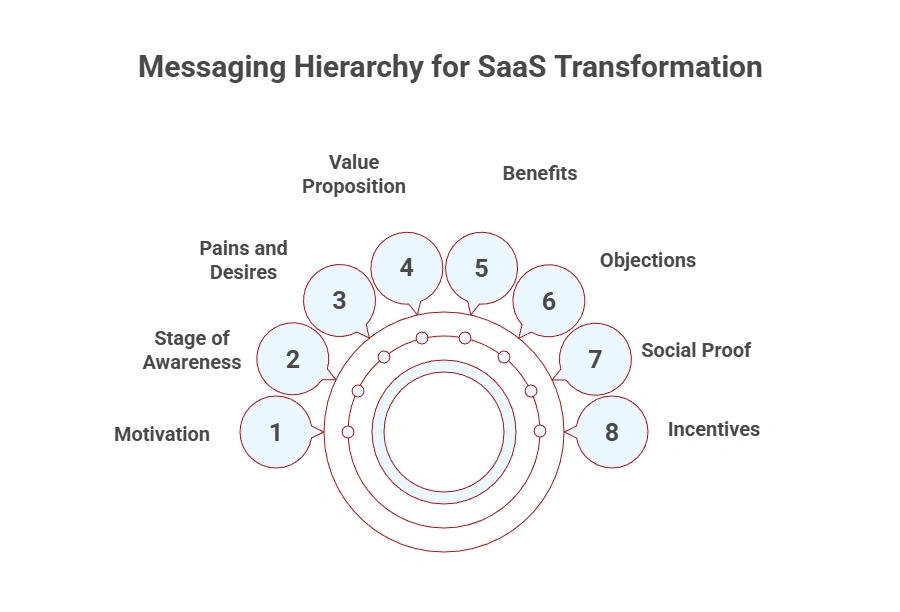
To help bring this hierarchy to life, here are simple examples using typical SaaS scenarios.
From pain → a “before” headline
Pain: “I’m drowning in manual admin.”
Headline: “Stop losing hours to repetitive tasks that should handle themselves.”
From desire → a promise of a better future
Desire: “I want clarity and confidence.”
Promise: “Finally understand what’s happening in your business at a glance.”
From testimonial → a proof statement
Customer: “We cut our reporting time from 3 hours to 10 minutes.”
Proof copy: “Teams cut reporting time by 95% without changing their workflows.”
From objection → reassurance copy
Objection: “Will this integrate with our current tools?”
Reassurance: “Works instantly with the tools you already use. No migration needed.”
Tying these elements together creates messaging that proves your product’s transformational value.
Step 6. Write Messaging That Shows, Not Tells, the “Better Version”
The next step is to turn our insights into copy that shows the transformation your SaaS delivers. Go beyond merely telling readers what your product does, and show them.
Here are 5 tips to help:
1. Use vivid, concrete outcomes instead of abstract claims
Abstract benefits sound impressive, but rarely land. Concrete outcomes, pulled from real user insights, help the reader instantly imagine their upgraded future self.
Instead of vague statements like “streamline your workflow,” give specific, sensory descriptions of relief, control or clarity. Clarity and specificity increase believability because they anchor the promise in real experience rather than wishful thinking.
2. Show what life looks like after using the product
Transformation isn’t theoretical. It should feel tangible. Reflect the visitor’s motivations and desired outcomes, showing not just what the product does but what the customer gets in their life after using it.
Paint the “after” state. More time with family. Workdays that feel manageable. Reports that take minutes instead of hours. Confidence replacing uncertainty.
3. Reflect their own words back to them
The best converting copy comes from customers, not from inside your head. Using their exact phrasing builds trust and creates the sense that you truly understand them.
Potential customers feel understood when they see their own thoughts, frustrations and hopes echoed on the page. This resonance is what moves them forward in the buying journey.
4. Highlight the before-and-after contrast across the page
Transformation messaging works best when the gap between the customer’s current state and their desired state is clear. Contrast reveals value.
Before: scattered files, chaotic workflows, late nights catching up.
After: structure, clarity, predictability.
Tapping into pain and motivation helps prospects recognise why they need your solution and begin “nodding along” as they read. Make the shift visible so the reader can step into the story.
5. Avoid generic “one size fits all” messaging
Trying to appeal to everyone is a conversion killer. The messaging becomes vague and emotionally empty.
As the saying goes, “Try to please everyone, and you please no one.”
You risk doing this when you write for 100% of your visitors instead of the segment most likely to buy. Your messaging ends up vague and generic, interchangeable with every SaaS competitor.
Messaging must be specific. Target the 20 to 35% who truly need your solution, using language that reflects their pains, desires and motivations.
Follow these 5 tips to show them, rather than telling them, exactly how you transform their life. Do that, and your SaaS stops being a set of features and becomes a catalyst for change.
You give prospects a story they can see themselves in. You give them a path from who they are now to who they want to become. And that is what converts.
Conclusion
SaaS messaging becomes powerful the moment it stops describing what a product does and starts reflecting who the customer wants to become. Great copy doesn’t come from founder intuition, internal brainstorming or clever wordsmithing.
Customers give you the best copy, with their own words, shaped by their pains, desires and motivations. Anchor your messaging in their lived experience and create a story they instantly recognise as their own.
The transformation-first approach is the fastest and most reliable path to differentiation and conversion in a crowded SaaS market.
Competitors can copy your features. They can’t copy the emotional journey your product initiates or the specific language your customers use to describe it.
Mirror that in your messaging and become magnetic.
When to Bring in an Expert
Going through these steps helps you create powerful SaaS messaging. But they also require time, patience and a specific skill set.
You need to be careful with voice of customer research, interviews, review mining, social listening and support inbox analysis to uncover the real pains, desires and motivations that drive conversions.
- Your messaging is only as strong as the research behind it.
- If the inputs are weak, the copy will be dodgy.
- Messaging built on assumptions instead of evidence rarely converts.
For SaaS founders, the challenge isn’t the ability or willingness to follow these steps. It’s the time commitment.
Running interviews. Scraping reviews. Analysing transcripts. Synthesising patterns. Mapping motivations and awareness levels. Organising messages into a hierarchy.
This is deep work.
Do it quickly or superficially, and the result is generic messaging that sounds like everyone else. You risk building an entire growth strategy on the wrong story.
Working with experts becomes the shortcut to clarity. Instead of spending weeks gathering insights and months refining messaging, you can outsource the heavy lifting.
That’s exactly where we can help.
You get two senior copywriters on the case (for the price of one).